
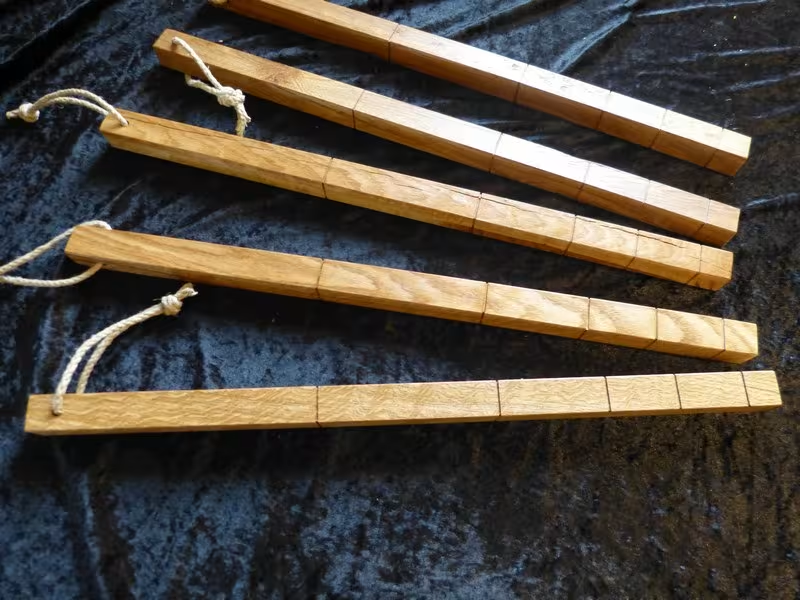
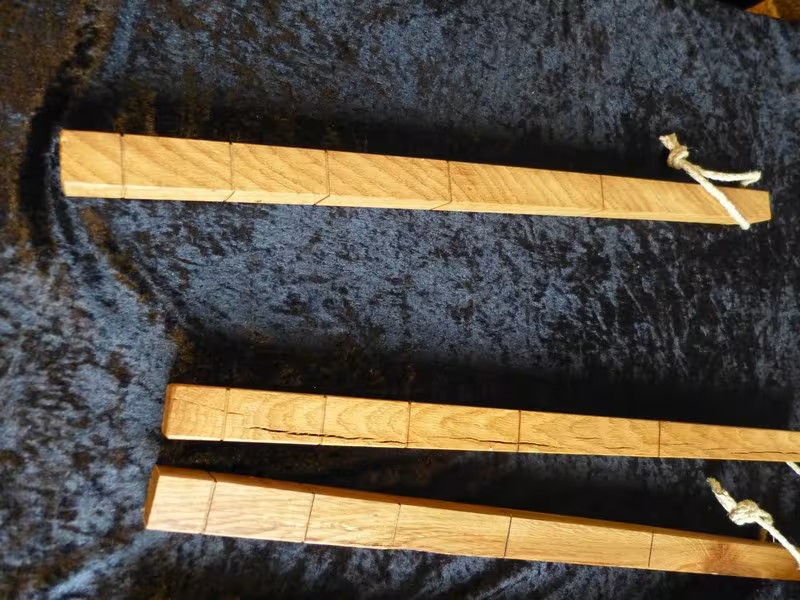
Builders' rod (pige)
12 €
It is now commonly accepted that the pige was also a standardised rod one inch thick and one cubit long, subdivided by notches marking five anthropic units: palm, palma, span, foot and cubit
This rod of the medieval builders, also called a virga, is thought to have been one of the typical measuring instruments of the master builder, along with the thirteen-knot rope.
The measures used on the medieval pige are thought to have been anthropomorphic units based on the human body, which varied with each architect:
- The inch: approx. 2.5 cm
- the palm (width of the hand): approx. 7.5 cm
- the palma (distance between the outstretched index and little fingers): approx. 12.5 cm
- the span (between the little finger and the thumb): approx. 20 cm
- the foot: approx. 32.5 cm
- the cubit (length of the forearm): approx. 52.5 cm
These rods are made of oak, treated with linseed oil and fitted with a hemp cord for attaching them.
- Materials
- Chêne,chanvre, huile de lin
- Periods
- Antiquity, Merovingians and Carolingians, Middle Ages, 12th-13th centuries (Crusades), Hundred Years' War and 15th century, Renaissance, 17th century