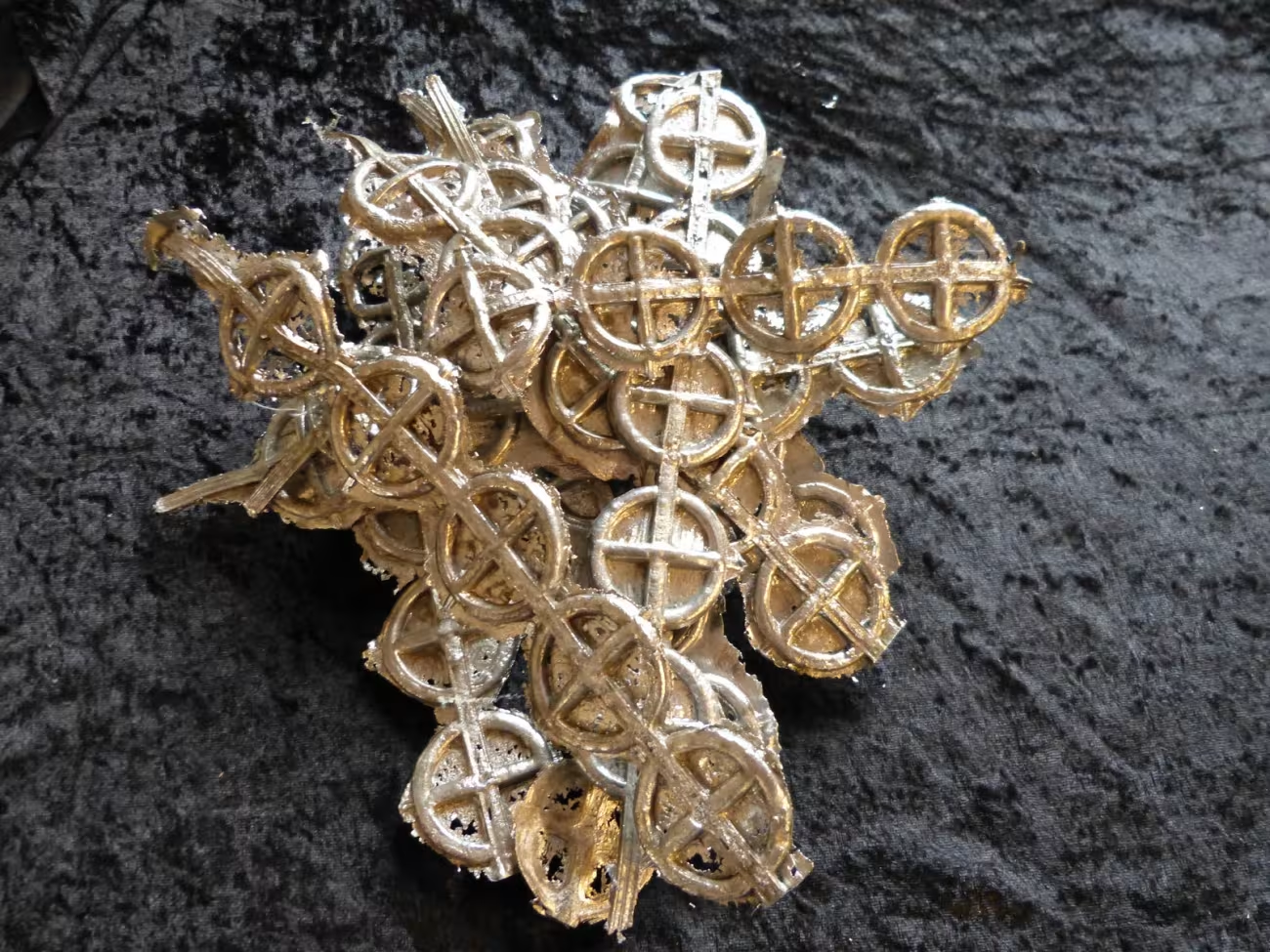

Celto-Roman lead funerary wheel pendants (rouelles)
7€ pcs, 30€ la bande de 5
They already existed in the Bronze Age. They were decorative items, worn as pendants or on jewellery. As the religion and beliefs of the period are very poorly known, their meaning can only be guessed at (most probably a solar symbol).
Wheel pendants (rouelles) of the Celtic and Gallo-Roman periods are the best known. They are small wheels with straight spokes, which may be made of various metals (lead, bronze, silver or gold). Those in low-value metals were cast to be produced in large numbers, whereas those in gold or silver were more finely worked. These rouelles were sewn onto clothing, worn as pendants, or used as votive offerings.
Strips of several lead rouelles, left as cast and not deburred, are found in graves. These pieces were probably symbols meant to accompany the dead on their journey.
The wheel, the swastika and the triskele were one and the same symbol, that of the god Taranis, a celestial deity of thunder. With Romanisation, this god was assimilated to Jupiter, who was often depicted holding a thunderbolt. He became a Jupiter-Taranis, whose representations show him bearing a thunderbolt and a wheel.
- Materials
- Plomb
- Periods
- Antiquity