Merovingian bird-shaped fibula
35 €
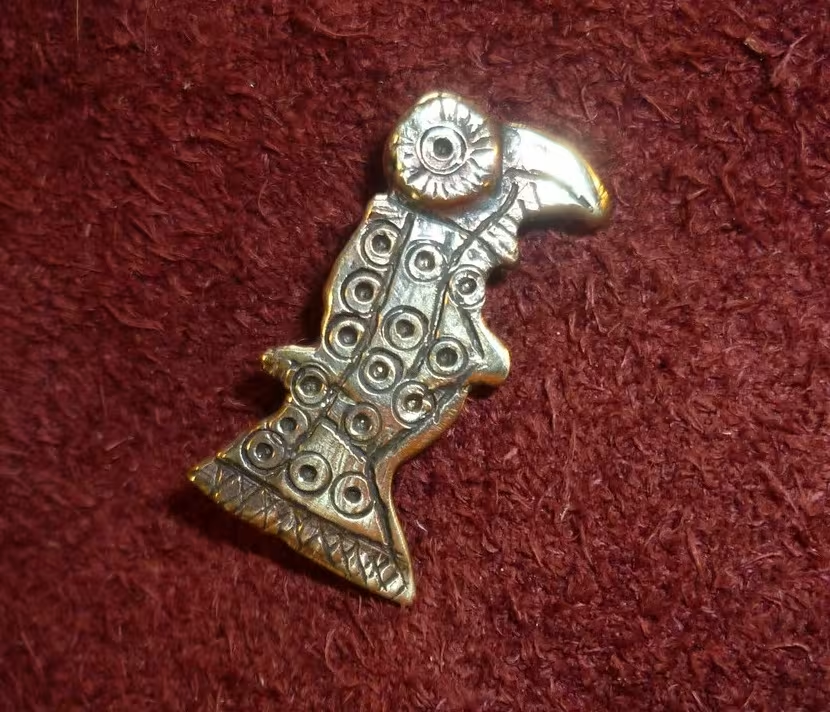
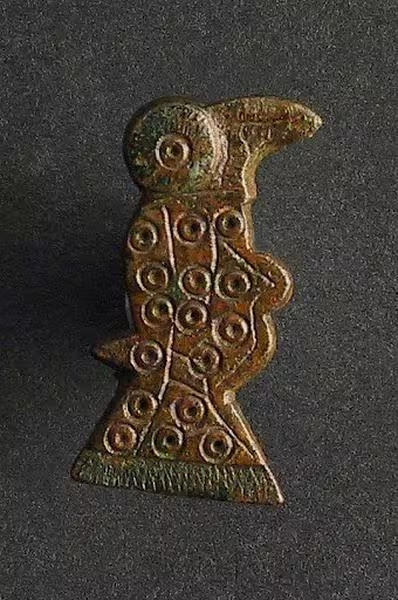
Zoomorphic fibula of the so-called “royal eagle” type, flat, with a hinged pin, depicting a stylised bird in profile.
The head is formed by a raised circle in which the eye appears as a punched ring-and-dot.
This eye is surrounded by grooves. On the original, the grooves were probably inlaid with niello or tinned.
The beak is elongated: it recalls a toucan’s rather than a bird of prey’s. The corner of the beak is marked by an incised line. The edges of the fibula are punctuated by projecting lugs, convex on the belly and pointed on the back. The decoration of the bird’s body consists of small punched ring-and-dot motifs, separated from one another by incised lines. The dovetailed tail bears the same type of decoration (ring-and-dots and incised lines) as the rest of the body, except for its lower part, decorated with vertical parallel grooves.
The bird-shaped type originated in central and eastern Germania. It is common in the Merovingian world, with a greater concentration in northern and eastern Gaul. Bird-shaped fibulae are generally dated to the 6th and early 7th centuries AD.
They were superseded in the 7th century by equal-arm bow fibulae. According to Cl. Lorren (cf. Cl. Lorren, “Fibules et plaques boucles en Normandie”, thesis, Caen, 1986, p. 255), this fibula appears in western Gaul only from the second half of the 6th century and disappears in the mid-7th century.
Given the origin of this fibula, the logical dating appears to be: second half of the 6th century to mid-7th century.
This fibula can be made in silver, or in bronze tinned partly (eye and tail) or entirely.
Dimensions: length 2.8 cm; width 1.5 cm; thickness 0.9 cm
- Materials
- Bronze, acier Au choix : Argent, Bronze.
- Periods
- Merovingians and Carolingians